

Many industries are changing as a result of Artificial Intelligence’s (AI) unrelenting advance, but the healthcare sector stands out since it is about to undergo a major change. Imagine a healthcare system that prioritises accuracy, maximises productivity, and takes a patient-centred stance. AI offers answers to healthcare problems, including lengthy wait times and the intricacy of medical data. AI systems that have been trained on big medical picture datasets are capable of accurately analysing scans, maybe identifying illnesses early on. Better patient outcomes and treatment plans may arise from this early detection. But AI’s impact extends beyond diagnosis. AI can create individualised healthcare strategies that go beyond a one-size-fits-all strategy by analysing a person’s composition. Additionally, AI-powered virtual assistants aid individuals in taking charge of their own health management. As we venture into this new era in healthcare, let’s delve into the power of AI and how it is set to revolutionise patient care.
Applications of AI in patient care
The pie chart detailing the top AI trends in healthcare for 2023 reveals that Healthcare Analytics dominates the sector, accounting for 26% of the focus. This trend emphasises the use of machine learning algorithms to analyse vast amounts of medical data, enabling early disease detection, risk forecasting for chronic patients, and improving the accuracy and speed of drug discovery. Medical Diagnostics, representing 22%, follows closely, highlighting AI’s role in streamlining diagnostic processes and reducing human error. Telehealth, at 19%, showcases AI’s impact on virtual consultations and remote patient monitoring. Other notable trends include Medical Robots (8%), Hospital Management (7%), Clinical Decision Support (6%), and a collective 12% covering various other innovations. These trends collectively illustrate AI’s significant contribution to enhancing healthcare delivery, efficiency, and patient outcomes in 2023.
Telehealth
Telehealth utilises telecommunication technologies to enable healthcare consultations and services. Online healthcare allows patients to connect with healthcare professionals, overcoming geographical barriers and providing convenience. Telehealth brings benefits to both patients and healthcare providers. Patients gain access to healthcare, especially those who are living in remote areas or dealing with mobility issues. Virtual appointments can cover routine checkups, medication management, and even mental health support. This flexibility helps patients prioritise their well-being easily.
For healthcare providers, telehealth offers increased efficiency and a wider reach. Telehealth allows healthcare providers to oversee patient care from a distance, serve a broader patient base, and optimise their schedules accordingly. Moreover, telehealth plays a role in reducing the spread of diseases by minimising face-to-face interactions. Nevertheless, it’s essential to recognise that telehealth may not be suitable for every situation. Complex medical conditions or procedures requiring examinations may still require in-person visits.
Diagnosis and disease detection with AI
The key to treatment often lies in detecting issues early on; this is where AI serves as an ally in the field of healthcare. AI algorithms are undergoing an evolution and are being trained on vast collections of medical scans, images, and patient information. Through the analysis of this data, they can spot patterns and irregularities that even experienced medical professionals might overlook. This data-focused approach shows potential for improving disease detection. Picture a scenario where the physician uses AI to examine the patient’s X-ray or MRI results. With its training on millions of cases, the AI system can pinpoint abnormalities with remarkable precision. Early detection like this could be a game-changer, facilitating intervention when treatments are most effective and empowering patients and doctors to manage health concerns.
The advantages of using AI for diagnosis extend beyond identification. AI can swiftly and accurately analyse large volumes of data, potentially enhancing precision. While human radiologists may experience fatigue, leading to missed details, AI provides a viewpoint and acts as a valuable second opinion for complex cases. This results in a reduction in errors and misdiagnoses, ultimately improving patient outcomes. However, some challenges need to be addressed. Biases can emerge within AI algorithms if the training data is biased itself. To ensure fairness and inclusivity, diverse datasets are essential for training AI systems. This requires collaboration among healthcare professionals, researchers, and AI experts to create a representation of human health. AI is not meant to replace doctors but rather enhance their skills. By offering a tool and unwavering support, AI has the potential to transform disease detection. This exciting new phase in healthcare sets the stage for a doctor-patient relationship with AI serving as an insightful partner on the journey to improved health.
Personalised medicine and AI-driven treatment plans
Healthcare is evolving toward a more precise approach, with AI playing a crucial role in driving this transformation. In the past, treatment plans were based on diagnoses and historical population trends. However, AI unlocks the potential for personalised medicine, tailoring therapies to a patient’s specific needs. This shift is powered by AI’s capacity to analyse health data, including genetic details, comprehensive medical histories, and other related factors. By scrutinising this health information, AI can detect distinct patterns and differences that lead to more tailored treatments. This strategy aligns with the increasing focus on precision medicine of using an individual’s characteristics to customise therapies accordingly. It is like optimising treatment plans based on data insights. AI excels at processing datasets to pinpoint tendencies and forecast how patients will respond to particular drugs and suggest alternative treatment paths based on each patient’s distinct biology.
The advantages of personalised treatment are quite significant, as it helps in increasing the effectiveness of treatment. Just picture a situation where a cancer patient is provided with a treatment strategy specifically tailored to target their mutation, enhancing the likelihood of a successful outcome. Moreover, personalised medicine can result in a reduction in side effects. By anticipating how a patient might respond to a medication, the dosage can be adjusted. This not only enhances comfort during the treatment but also reduces the chances of complications. Although AI serves as a tool in optimising patient care, it is crucial to acknowledge that it acts as an assistant rather than a substitute for medical expertise. The interpretation of AI insights and the development of the treatment plan will always necessitate the skills and knowledge of medical professionals.
AI-Powered Robotics and Minimally Invasive Surgery
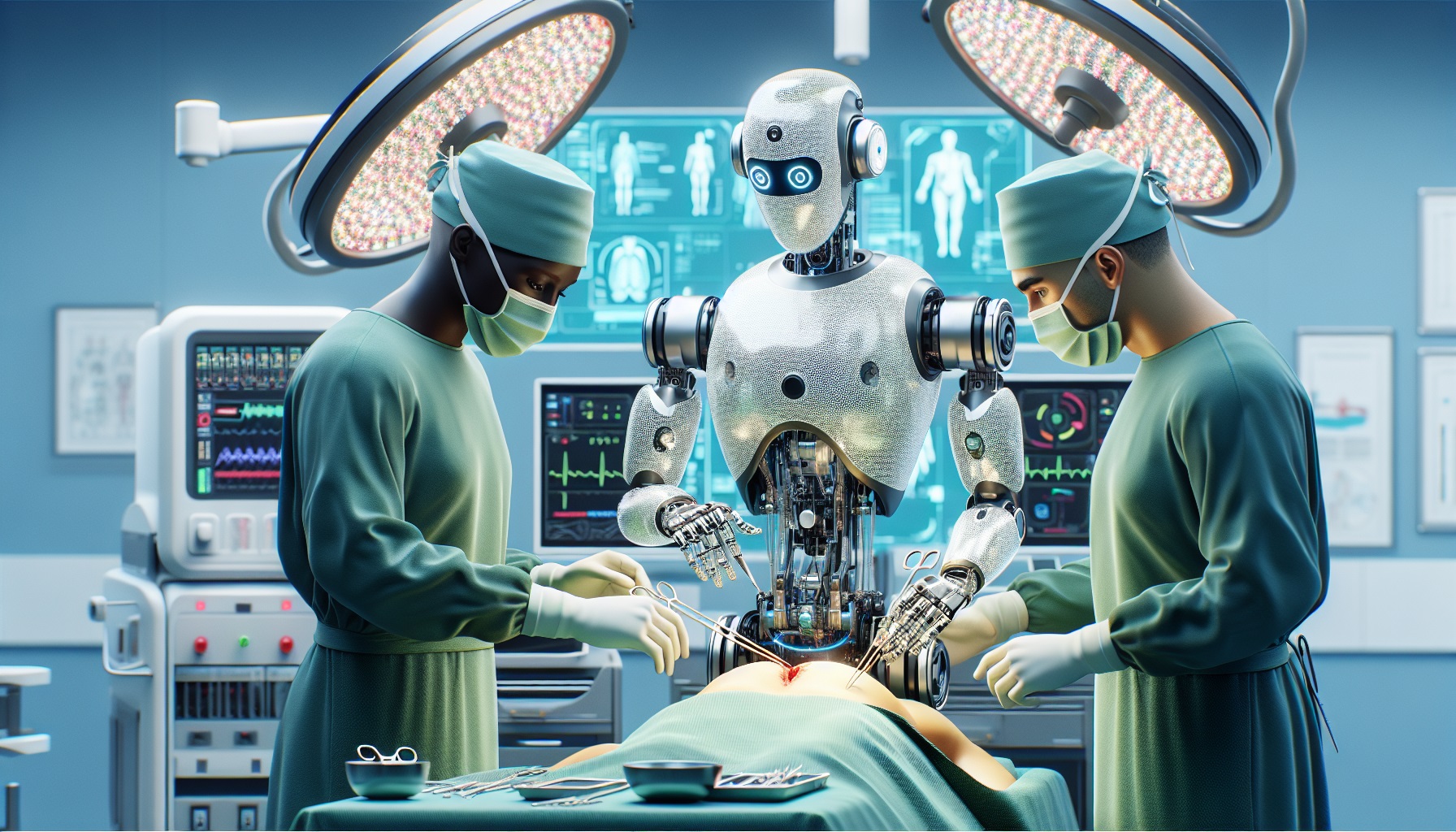
Robotic systems used in surgeries, once seen in science fiction, are now becoming more advanced and achievable with the help of AI. Visualise a scenario where a surgeon operates using an arm guided by AI, carrying out procedures with unmatched precision and control. This showcases the future that AI-powered robotics is bringing about. One significant advantage of AI in surgery is its ability to improve precision. By analysing real-time data from the operation site, such as instrument positions and tissue feedback, AI algorithms enable movements by the robotic arms, potentially reducing human error and enhancing overall surgical precision. Additionally, AI can assess scans done before surgery and produce representations to give surgeons a detailed plan for the procedure ahead.
This enhanced visualisation improves surgical planning and execution, leading to more predictable and successful outcomes. The benefits of AI-assisted surgery extend beyond just precision. Robotic arms, guided by AI, can boast a wider range of motion compared to the human hand. This allows surgeons to access hard-to-reach areas within the body, facilitating minimally invasive procedures. Minimally invasive surgery offers numerous advantages for patients. Smaller incisions translate to faster recovery times, reduced post-operative pain and a shorter hospital stay. Additionally, AI can assist in tasks like blood vessel identification and delicate tissue manipulation, minimising surgical trauma and potential complications.
Remote patient monitoring and proactive healthcare
The healthcare landscape is expanding beyond the walls of hospitals and clinics. AI plays a role in this evolution, enabling the monitoring of patients from a distance and introducing an era of proactive healthcare. Envision a future where healthcare professionals can keep tabs on your signs and health indicators in time, regardless of where you are. This is not just wishful thinking: it is the reality that AI is shaping. By utilising gadgets and sensors, AI streamlines patient monitoring. These tools gather an array of information, ranging from heart rate and blood pressure to sleep patterns and activity levels. Advanced algorithms then sift through this data flow, pinpointing patterns and potential deviations. This capability empowers healthcare providers to supervise patients, intervene promptly when needed and ensure medical care whenever necessary.
The real strength of AI lies in its capability to foresee health concerns before they worsen. Predictive analytics, a branch of AI, can examine a patient’s background, lifestyle information and current health data. By recognising trends and risk elements, AI can anticipate health issues before they emerge. This enables steps like adjusting medications or making lifestyle changes to avert severe health complications. The advantages of AI-driven monitoring and proactive healthcare are manifold. Enhanced patient safety stands out as a benefit. By detecting health issues early on, we can prevent them from evolving into more critical conditions. This not only enhances results but also alleviates the strain on healthcare systems. Moreover, proactive healthcare could result in fewer hospital readmissions.
Conclusion
From revolutionising disease detection to empowering remote patient monitoring, AI is transforming healthcare at an unprecedented pace. AI systems trained on datasets are proving invaluable in spotting diseases, which could result in better treatment strategies and enhanced patient outcomes. Personalised healthcare, made possible by AI’s capacity to analyse patient information, is paving the way for tailored treatment plans that cater to each patient’s requirements. The integration of AI-powered robotics is revolutionising surgery by offering enhanced precision and control, leading to quicker recovery periods and reduced patient distress.
Nonetheless, as we step into this future, concerns related to data privacy and potential biases inherent in AI algorithms must be addressed with great care. It is crucial to ensure the development and implementation of AI in healthcare to uphold fairness, transparency and safeguard patient data. Looking ahead, the potential of AI in healthcare appears limitless. The capability of AI to analyse huge quantities of data may pave the way for groundbreaking advancements in drug discovery and the creation of more efficient treatment options. In addition, virtual assistants powered by AI could have an impact on educating and supporting patients, enabling individuals to become more involved in managing their well-being. With the advancement of AI, in healthcare facilities, we envision a future where the emphasis is placed on preventive care, resulting in a healthier and more empowered community.


